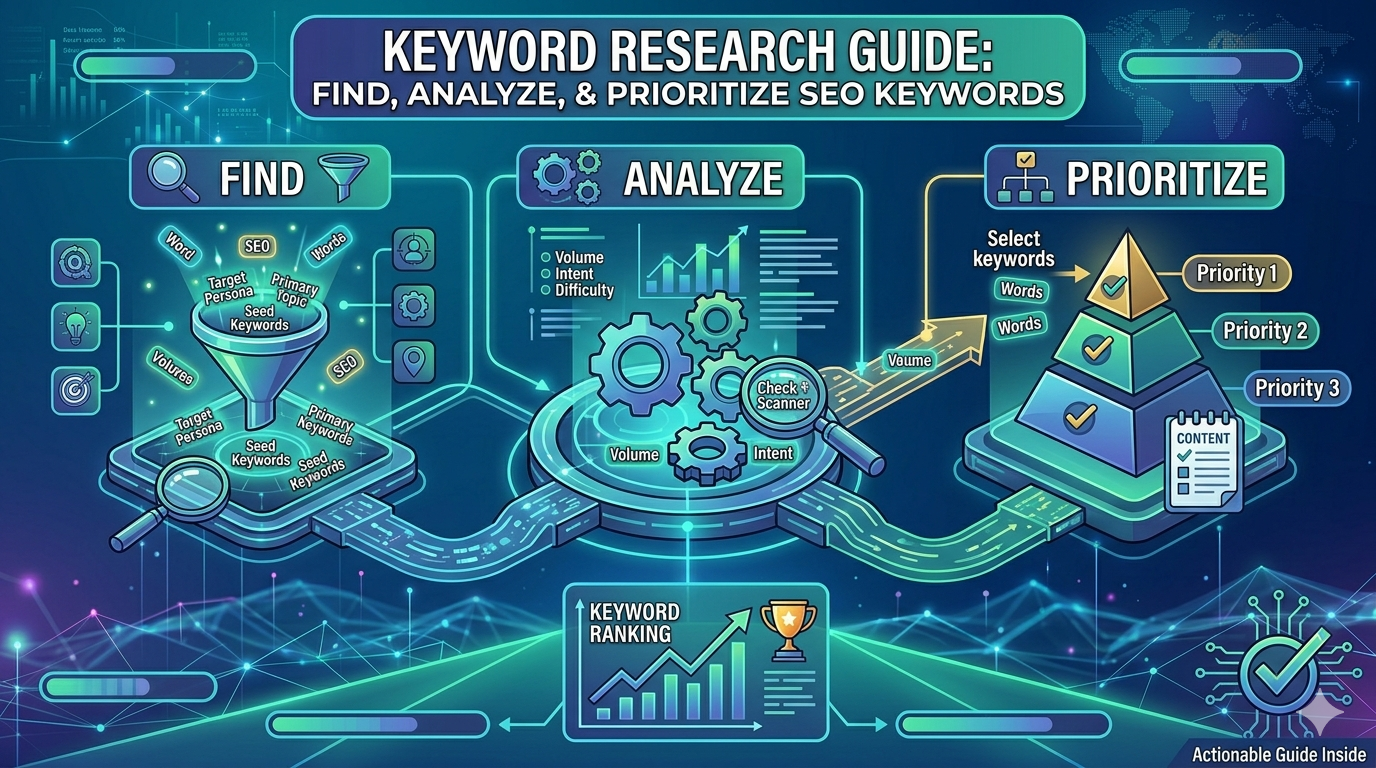
Keyword research is the foundation of every successful SEO strategy. Before you write
- A blog post
- Build a landing page
- Launch an affiliate website or
- Optimize a business website
you need to understand what your audience is actually searching for.
Without keyword research, content creation becomes guesswork.
You may write a well-designed article, but if it does not match real search demand, search intent, or business goals, it may never bring meaningful organic traffic.
Keyword research helps you discover the exact words, questions, and phrases people use in Google, YouTube, forums, ecommerce platforms, and even AI tools.
It also helps you understand what users want, how competitive a topic is, and which keywords are worth targeting.
In this guide, you will learn
- what keyword research is, why it matters
- how to do keyword research step by step
- which tools to use, how to analyze search intent and
- how to optimize your keyword strategy for SEO, AEO, GEO, and LLM-based search.
What Is Keyword Research?
Keyword research is the process of finding and analyzing the search terms people use when looking for information, products, services, or solutions online.
In simple words, keyword research helps you answer three important questions:
- What is my audience searching for?
- Why are they searching for it?
- What type of content should I create to satisfy that search?
For example, someone searching “what is keyword research” wants a beginner-friendly explanation.
Someone searching “best keyword research tools” is comparing options.
Someone searching “keyword research service” may be ready to hire an SEO expert.
That is why keyword research is not only about search volume.
It is about understanding user intent, business value, ranking difficulty, and content opportunities.
Why Keyword Research Is Important for SEO?
Keyword research is important because it connects your content strategy with real audience demand.
Instead of guessing topics, you use data to create content people are already searching for.
Here are the main benefits of keyword research:
- It helps you understand your target audience.
- It reveals what questions users are asking.
- It helps you match content with search intent.
- It improves your chance of ranking in search results.
- It helps you find low-competition opportunities.
- It supports blog, service page, affiliate, and ecommerce content planning.
- It helps prevent keyword cannibalization.
- It improves your SEO, AEO, GEO, and AI-search visibility.
- It helps prioritize content based on business value.
Keyword research also helps you avoid wasting time on content that may look useful but has no search demand or conversion potential.
Google says its automated ranking systems are designed to prioritize helpful, reliable, people-first content rather than content created mainly to manipulate search rankings.
Keyword Research in the Age of AI Search
Modern keyword research is no longer limited to traditional Google rankings.
Users now search through Google, YouTube, Reddit, Quora, TikTok, Amazon, ChatGPT, Gemini, Perplexity, and other AI-powered platforms.
This means your keyword strategy should include:
- Traditional search queries
- Long-tail questions
- Conversational prompts
- Problem-based searches
- Comparison keywords
- Entity-rich topics
- People Also Ask questions
- AI Overview-style direct answers
For example, a traditional keyword may be:
“keyword research tools”
An AI-style prompt may be:
“What is the best keyword research process for a beginner affiliate marketer with a new website?”
Both are valuable, but they require slightly different content formatting. To perform well in AI-driven search environments, your content should include direct answers, clear definitions, structured lists, examples, comparison tables, and trustworthy references.
| Example Keyword | SEO Optimization | GEO Optimization | AEO Optimization | LLM Optimization |
| How to choose kitchen storage containers | Write a helpful guide that explains the topic clearly. | Make the content easy for AI search to summarize. | Give a short direct answer at the top. | Use clear facts, related terms, and examples. |
| Best kitchen storage containers | Create comparison content with pros, cons, and product options. | Explain why each option is best for different users. | Answer questions like “Which one is best?” | Mention product features, benefits, and use cases clearly. |
| Buy airtight kitchen containers | Optimize product pages with price, reviews, CTA, and shipping info. | Give clear product details AI can use in recommendations. | Answer buying questions like “Where to buy?” | Keep product name, price, size, material, and benefits consistent. |
| Orivohome kitchen containers | Make sure the official brand/page is easy to find. | Help AI understand this is the official source. | Answer “What is Orivohome?” clearly. | Build a clear brand profile with categories and products. |
| Type | Main Goal |
| SEO | Rank higher on Google search results. |
| GEO | Appear in AI-generated search answers. |
| AEO | Become the short direct answer. |
| LLM Optimization | Help AI tools understand and recommend your brand/content. |
For the keyword “best kitchen storage containers”:
| Optimization Type | What to Do |
| SEO | Write a blog post: “Best Kitchen Storage Containers for Small Kitchens.” |
| GEO | Add summaries, comparisons, and clear recommendations. |
| AEO | Add a direct answer: “The best kitchen storage containers are airtight, stackable, and space-saving.” |
| LLM | Clearly mention materials, sizes, benefits, use cases, and brand name. |
Types of Keywords in SEO
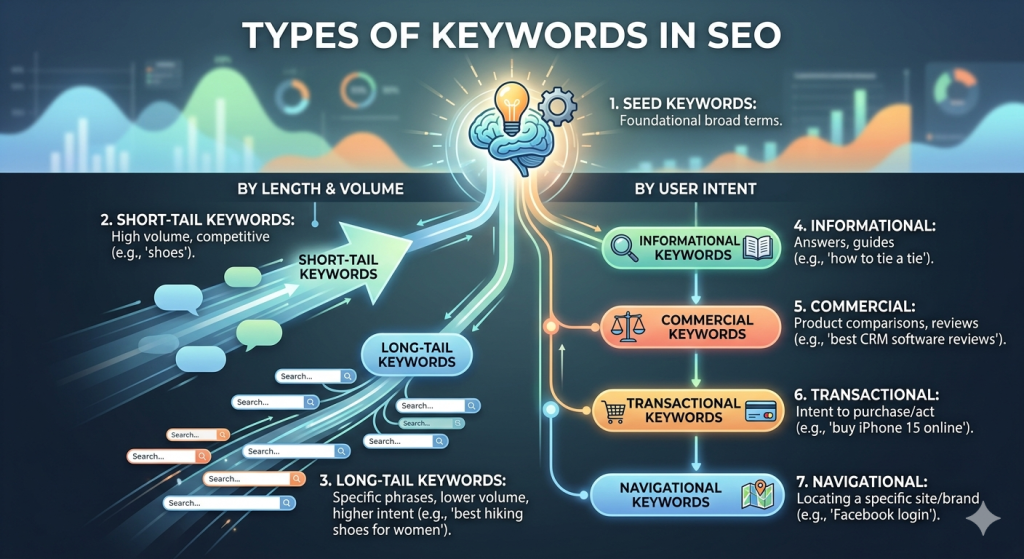
Understanding keyword types helps you choose the right keyword for the right page.
1. Seed Keywords
Seed keywords are broad starting keywords related to your niche.
Examples:
- SEO
- Keyword research
- Digital marketing
- Affiliate marketing
- Content writing
Seed keywords are usually too broad to target alone, but they help you generate more specific keyword ideas.
2. Short-Tail Keywords
Short-tail keywords are short, broad search terms with high search volume and high competition.
Examples:
- Keyword research
- SEO tools
- Digital marketing
These keywords are usually best for pillar pages or authority websites.
3. Long-Tail Keywords
Long-tail keywords are longer and more specific phrases.
Examples:
- How to do keyword research for SEO
- Best keyword research tools for beginners
- How to find low competition keywords
- Keyword research for affiliate marketing
Long-tail keywords often have lower competition and higher conversion potential because they match specific user needs.
4. Informational Keywords
Informational keywords are used when people want to learn something.
Examples:
- What is keyword research?
- How does keyword research work?
- Why is keyword research important?
These are ideal for blog posts, guides, tutorials, and educational content.
5. Commercial Keywords
Commercial keywords show that the user is comparing options before making a decision.
Examples:
- Best keyword research tools
- Ahrefs vs Semrush
- Free vs paid keyword research tools
These keywords are great for listicles, comparison articles, review posts, and affiliate content.
6. Transactional Keywords
Transactional keywords show strong buying or action intent.
Examples:
- Hire keyword research expert
- Keyword research service
- Buy SEO keyword report
These keywords are best for service pages, landing pages, and conversion-focused content.
7. Navigational Keywords
Navigational keywords are used when users want to find a specific brand, tool, or website.
Examples:
- Google Keyword Planner
- Google Search Console
- Semrush keyword tool
- Ahrefs keyword explorer
| Keyword Type | Practical Example | Best Page Type |
| Seed Keywords | SEO, keyword research, digital marketing | Keyword research planning |
| Short-Tail Keywords | Keyword research, SEO tools | Pillar pages, category pages |
| Long-Tail Keywords | How to do keyword research for SEO | Blog posts, tutorials, niche guides |
| Informational Keywords | What is keyword research? | Blog posts, guides, FAQs |
| Commercial Keywords | Best keyword research tools | Listicles, comparison posts, reviews |
| Transactional Keywords | Hire keyword research expert | Service pages, landing pages |
| Navigational Keywords | Google Keyword Planner, Ahrefs keyword explorer | Brand pages, tool pages, product pages |
Search Intent: The Most Important Part of Keyword Research
Search intent is the reason behind a search query.
If your content does not match search intent, it will be difficult to rank even if you use the right keyword.
There are four main types of search intent:
| Search Intent | User Goal | Example Keyword | Best Content Type |
| Informational | Learn something | What is keyword research? | Blog post or guide |
| Navigational | Find a specific site/tool | Google Keyword Planner | Tool page or tutorial |
| Commercial | Compare options | Best keyword research tools | Listicle or comparison |
| Transactional | Take action | Keyword research service | Landing page |
To analyze search intent, search your primary keyword and study the top-ranking pages.
Look at their titles, headings, content format, SERP features, People Also Ask questions, videos, and related searches.
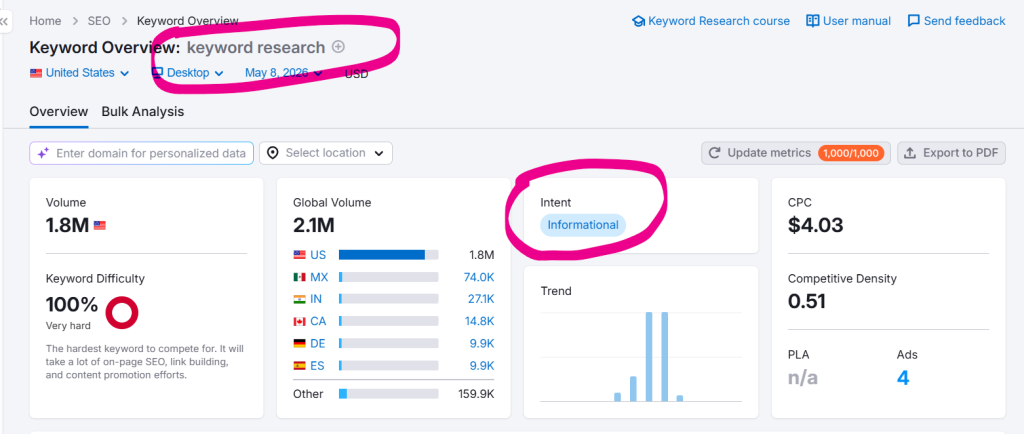
For the keyword “Keyword Research,” the dominant search intent is informational.
Users want to learn what keyword research is and how to do it. That means a complete guide or pillar article is the best content format.
You can use paid tools to find out the search intent of any keywords such as
Important Keyword Research Metrics
Keyword research tools provide different metrics. The most important ones are search volume, keyword difficulty, traffic potential, CPC, trends, and business value.
Search Volume
Search volume shows how many times a keyword is searched during a specific time period.
A high-volume keyword can bring more visibility, but it usually has more competition.
However, search volume should not be your only decision factor.
A keyword with lower search volume but stronger intent may bring better leads, sales, or conversions.
Keyword Difficulty
Keyword difficulty estimates how hard it may be to rank for a keyword.
Different SEO tools calculate this score differently, so it should be used as a guide, not an absolute truth.
When analyzing difficulty, check:
- Domain authority of ranking pages
- Backlink profiles
- Content quality
- Search intent match
- Content depth
- Brand authority
- SERP features
Traffic Potential
Traffic potential means the total amount of traffic a page can attract from the main keyword and related keywords.
One page can rank for hundreds or thousands of keyword variations if it covers a topic deeply.
CPC
CPC stands for cost per click. It shows how much advertisers may pay for a click in paid search. A high CPC often suggests commercial value.
Trend
Keyword trends show whether interest in a topic is growing, stable, seasonal, or declining.
Google Trends or Paid tools like Semrush, Ahref can help content teams understand how people find information and refine their content strategy.
Business Value
Business value measures how closely a keyword connects to your product, service, or revenue goal.
For example:
- “What is keyword research?” = awareness keyword
- “Keyword research checklist” = lead generation keyword
- “Keyword research service” = conversion keyword
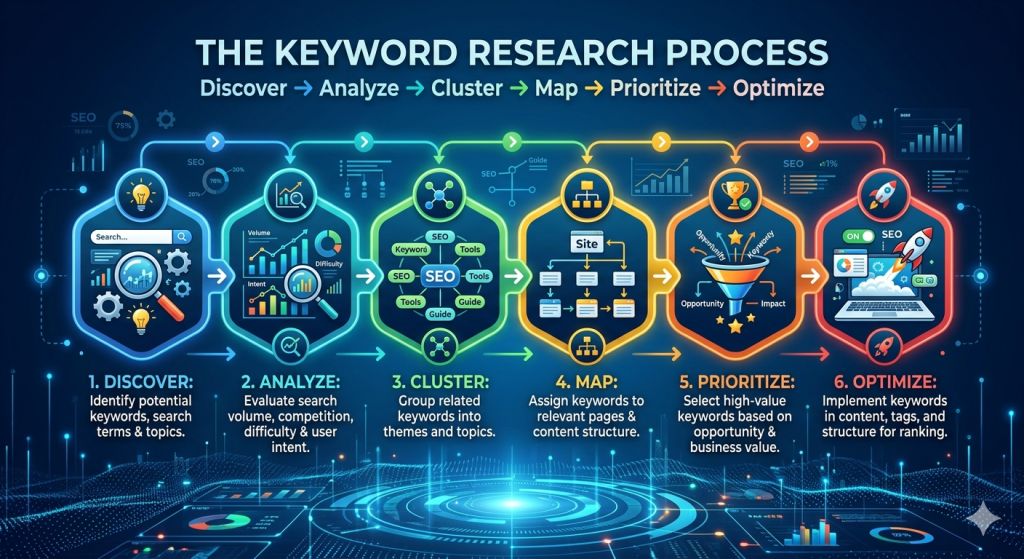
How to Do Keyword Research Step by Step
Now let’s walk through a complete keyword research process.
Step 1: Define Your SEO Goal
Before using any keyword tool, define your goal.
Ask yourself:
- Do I want more organic traffic?
- Do I want leads?
- Do I want affiliate sales?
- Do I want local customers?
- Do I want ecommerce sales?
- Do I want to build topical authority?
- Do I want better AI search visibility?
Your goal will influence the type of keywords you choose.
For example, an affiliate marketer may focus on commercial comparison keywords, while a service business may focus on transactional service keywords.
Step 2: Understand Your Target Audience
Keyword research starts with audience research.
You need to know:
- Who your audience is
- What problems they have
- What language they use
- What questions they ask
- What level of knowledge they have
- What solutions they are comparing
- What objections stop them from taking action
For this topic, the target audience includes SEO professionals, digital marketers, affiliate marketers, and website owners. These users need both beginner-friendly explanations and advanced keyword strategy advice.
Step 3: Brainstorm Seed Keywords
Seed keywords are the starting point of keyword research.
For the topic Keyword Research, seed keywords may include:
- Keyword research
- SEO keyword research
- Keyword analysis
- Keyword strategy
- Keyword planning
- Keyword tools
- Search intent
- Keyword mapping
- Long-tail keywords
Use these seed keywords inside SEO tools to discover related keyword ideas.
Step 4: Use Google Search Console for Existing Keyword Data
If your website already receives traffic, Google Search Console is one of the best places to begin.
You can find:
- Queries that bring users to your site
- Pages with high impressions but low clicks
- Keywords ranking on page two
- Pages with declining traffic
- Countries and devices where performance is strongest
- Search appearance data
Google Search Console says Search Analytics helps users see which queries bring traffic to a site and analyze impressions, clicks, and position on Google Search.
This data is powerful because it comes from your actual website performance, not just third-party estimates.
Step 5: Use Keyword Research Tools
Keyword research tools help you expand your keyword list and analyze opportunities.
Popular tools include:
- Google Keyword Planner
- Google Search Console
- Google Trends
- Ahrefs
- Semrush
- Moz
- Ubersuggest
- AnswerThePublic
- AlsoAsked
- LowFruits
- Keywords Everywhere
Use multiple tools if possible, because each tool has different data sources and keyword suggestions.
| Tool | Free or Paid? | Best For | Practical Example |
| Google Keyword Planner | Free | Finding keyword ideas, search volume, and CPC estimates | Find keywords like “keyword research tools” and check search demand. (Google Help) |
| Google Search Console | Free | Finding keywords your website already ranks for | Check which queries bring clicks to your blog post. (Google Help) |
| Google Trends | Free | Checking keyword popularity over time | Compare “Ahrefs” vs “Semrush” trend interest. (Google Trends) |
| Ahrefs | Paid | Competitor keyword research and backlink analysis | Find keywords your competitors rank for. (Ahrefs) |
| Semrush | Paid | SEO, PPC, competitor, and content research | Use Keyword Magic Tool to find keyword ideas. (Semrush) |
| Moz | Paid / some free tools | Keyword research, rank tracking, and SEO metrics | Check keyword difficulty and page authority. (TechRadar) |
| Ubersuggest | Free limited / Paid | Beginner-friendly keyword research | Find keyword ideas, SEO difficulty, and content ideas. (Ubersuggest) |
| AnswerThePublic | Free limited / Paid | Question-based keyword ideas | Find questions like “how does keyword research work?” (Ubersuggest) |
| AlsoAsked | Paid | People Also Ask questions | Build FAQ sections from real user questions. (AlsoAsked) |
| LowFruits | Paid / first analysis free | Finding low-competition keywords | Find easy-to-rank keywords for new websites. (LowFruits) |
| Keywords Everywhere | Paid credits | Quick keyword data inside browser | See search volume, CPC, and competition while searching Google. (Keywords Everywhere) |
Recommendation:
| User Type | Best Tool Combination |
| Beginner | Google Keyword Planner + Google Trends + Ubersuggest |
| Blogger | Google Search Console + AnswerThePublic + AlsoAsked |
| Affiliate Marketer | Ahrefs or Semrush + LowFruits + Keywords Everywhere |
| SEO Professional | Ahrefs + Semrush + Google Search Console |
| New Website Owner | LowFruits + Google Keyword Planner + AnswerThePublic |
Step 6: Analyze Competitor Keywords and Gap Analysis
Competitor keyword analysis helps you find keywords that other websites already rank for.
To analyze competitors:
- Search your primary keyword in Google.
- Identify the top-ranking pages.
- Review their titles, headings, and content structure.
- Check what subtopics they cover.
- Identify what they missed.
- Use SEO tools to find their ranking keywords.
- Look for content gaps and weak sections.
- Create a better, more complete version.
Competitor analysis should not mean copying. It means understanding what already works and then creating something more useful, updated, and complete.
Step 7: Study the SERP
SERP analysis means reviewing the search engine results page for your target keyword.
Look for:
- Featured snippets
- People Also Ask questions
- AI Overviews
- Video results
- Image packs
- Related searches
- Forum results
- Product results
- Local packs
- Top-ranking content types
For the keyword “Keyword Research,” the SERP usually favors educational guides, beginner tutorials, and tool-based resources. This means your content should be in-depth, well-structured, and beginner-friendly while also offering advanced insights.
Step 8: Collect Question-Based Keywords
Question keywords are very useful for AEO and LLM visibility.
Examples:
- What is keyword research?
- How do I do keyword research?
- What are keyword research tools?
- How do I find low competition keywords?
- What is search intent?
- How do I choose keywords for SEO?
- How many keywords should I use per page?
- What is keyword mapping?
These questions can be used in H2s, H3s, FAQ sections, and answer blocks.
Step 9: Group Keywords into Topic Clusters
Keyword clustering means grouping similar keywords by topic and search intent.
Example cluster:
Main Topic: Keyword Research
Supporting Keywords:
- SEO keyword research
- Keyword research tools
- Keyword analysis
- Search intent
- Keyword difficulty
- Long-tail keywords
- Keyword mapping
- Competitor keyword research
Instead of creating separate thin pages for every keyword, create one strong page that covers related keywords naturally.
This helps build topical authority and reduces keyword cannibalization.
Step 10: Map Keywords to Pages
Keyword mapping means assigning keywords to specific pages on your website.
Example:
| Page | Primary Keyword | Supporting Keywords | Intent |
| Pillar article | Keyword research | SEO keyword research, keyword analysis | Informational |
| Tool guide | Keyword research tools | Best free keyword research tools | Commercial |
| Service page | Keyword research service | Hire SEO keyword expert | Transactional |
| Template page | Keyword research template | Keyword mapping template | Informational/commercial |
Keyword mapping helps each page have a clear purpose. It also prevents multiple pages from competing for the same keyword.
Step 11: Prioritize Your Keywords
Not all keywords are worth targeting first. Use a scoring system to prioritize keywords.
Consider:
- Relevance
- Search intent
- Search volume
- Keyword difficulty
- Traffic potential
- Business value
- Conversion potential
- Trend
- Content gap opportunity
A good keyword is not always the one with the highest volume. A good keyword is one that matches your audience, your content type, and your business goal.
Step 12: Create a Keyword-Focused Content Brief
Before writing content, create a content brief.
A good SEO content brief should include:
- Primary keyword
- Secondary keywords
- Semantic keywords
- Search intent
- Target audience
- Suggested title
- URL slug
- Meta description
- H1, H2, and H3 structure
- Competitor gaps
- Internal links
- External references
- Multimedia suggestions
- FAQ questions
- CTA
- Schema markup recommendations
This makes the writing process faster, more organized, and more SEO-friendly.
Best Keyword Research Tools
Here are some useful keyword research tools for different needs.
| Tool | Best For |
| Google Search Console | Real website keyword performance |
| Google Keyword Planner | Keyword ideas and PPC data |
| Google Trends | Trend and seasonality research |
| Ahrefs | Keyword difficulty, backlink data, traffic potential |
| Semrush | Keyword gap, competitor research, content planning |
| Moz | Keyword difficulty and priority scoring |
| Ubersuggest | Beginner-friendly keyword ideas |
| AnswerThePublic | Question-based keywords |
| AlsoAsked | People Also Ask-style topic mapping |
| LowFruits | Low-competition keyword discovery |
Practical Keyword Research Planning Examples
| Business Type | Main Keyword Focus | Example Keywords | Best Content/Page Type |
| Dentist | Service + local keywords | dentist near me, dental clinic in Dhaka, teeth whitening service, emergency dentist | Service pages, location pages, FAQ pages |
| Electrician | Emergency + local service keywords | electrician near me, emergency electrician, electrical wiring service, ceiling fan installation | Service pages, emergency service page, local SEO pages |
| Cleaning Service | Service + commercial keywords | house cleaning service, office cleaning company, deep cleaning service, move-out cleaning service | Service pages, pricing page, comparison blog |
| Plumber | Emergency + problem-based keywords | plumber near me, emergency plumber, pipe leakage repair, bathroom plumbing service | Service pages, emergency page, problem-solution blog |
| Home Renovation | Project + service keywords | home renovation contractor, kitchen renovation, bathroom remodeling, home improvement service | Service pages, project gallery, cost guide blog |
| Ecommerce Clothing Store | Product + commercial keywords | women’s summer dress, men’s casual shirt, best jeans for women, buy cotton t-shirt online | Category pages, product pages, buying guides |
Keyword Plan by Intent:
| Business | Informational Keyword | Commercial Keyword | Transactional Keyword | Navigational / Local Keyword |
| Dentist | how often should I visit a dentist | best dental clinic for teeth whitening | book dentist appointment | dentist in NYC |
| Electrician | why does my circuit breaker trip | best electrician for home wiring | hire emergency electrician | electrician near NYC |
| Cleaning Service | how to deep clean a house | best cleaning service for apartments | book home cleaning service | cleaning service in NYC |
| Plumber | how to fix pipe leakage | best plumber for bathroom repair | call emergency plumber | plumber near me |
| Home Renovation | how to plan home renovation | best home renovation company | hire renovation contractor | home renovation company in NYC |
| Clothing Store | how to choose the right shirt size | best cotton t-shirts for summer | buy men’s cotton t-shirt online | orivohome clothing store |
Simple Rule:
| Keyword Type | Use For |
| Informational | Blog posts and guides |
| Commercial | Comparison pages and buying guides |
| Transactional | Product, service, and landing pages |
| Local/Navigational | Location pages and brand pages |
Practical Example:
For a plumber, the keyword plan can look like this:
| Page | Target Keyword |
| Homepage | plumber in NYC |
| Service Page | emergency plumbing service |
| Service Page | pipe leakage repair |
| Blog Post | how to stop water leakage at home |
| Location Page | plumber in NYC |
| FAQ Section | how much does a plumber cost? |
How to Optimize Keyword Research for AEO, GEO, and LLMs
Keyword research should now support more than traditional search rankings.
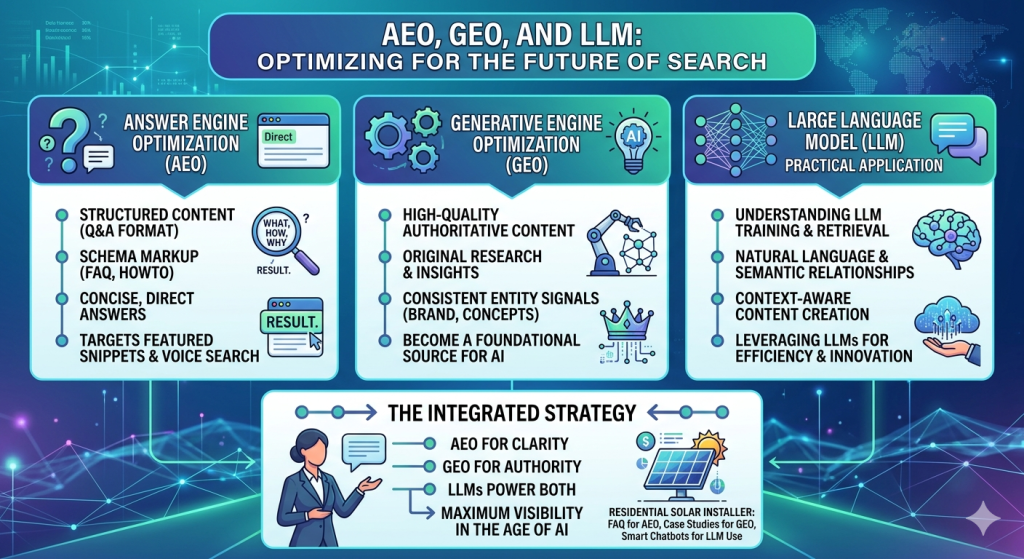
AEO: Answer Engine Optimization
AEO focuses on helping answer engines extract clear answers from your content.
To optimize for AEO:
- Use direct answer paragraphs
- Add FAQ sections
- Use question-based headings
- Keep definitions short and clear
- Add step-by-step lists
- Use tables and bullet points
- Add schema markup where appropriate
GEO: Generative Engine Optimization
GEO focuses on improving visibility in AI-generated answers.
To optimize for GEO:
- Include clear entity relationships
- Use trusted references
- Add expert insights
- Provide original examples
- Cover the topic comprehensively
- Use structured formatting
- Add concise summaries after complex sections
LLM Optimization
LLM-friendly content should be easy for AI systems to understand, summarize, and cite.
Use:
- Clear headings
- Simple definitions
- Lists
- Tables
- Examples
- FAQs
- Source references
- Consistent terminology
Schema.org provides shared structured data vocabularies that help search engines and other systems understand web page content more clearly.
Common Keyword Research Mistakes
Avoid these common mistakes:
- Targeting only high-volume keywords
High volume does not always mean high value. - Ignoring search intent
If your content format does not match intent, rankings will be difficult. - Choosing keywords without business value
Traffic is useful only when it supports your goals. - Not checking competitors
Competitor analysis helps you understand what quality level is required. - Ignoring long-tail keywords
Long-tail keywords often convert better and are easier to rank for. - Using one keyword per article only
A strong page can rank for many related keywords. - Creating duplicate content
Similar pages targeting the same intent can cause keyword cannibalization. - Not updating keyword research
Search behavior changes over time. - Depending only on tools
Tools are useful, but SERP analysis and audience research are also important. - Keyword stuffing
Use keywords naturally. Do not force them into every sentence.
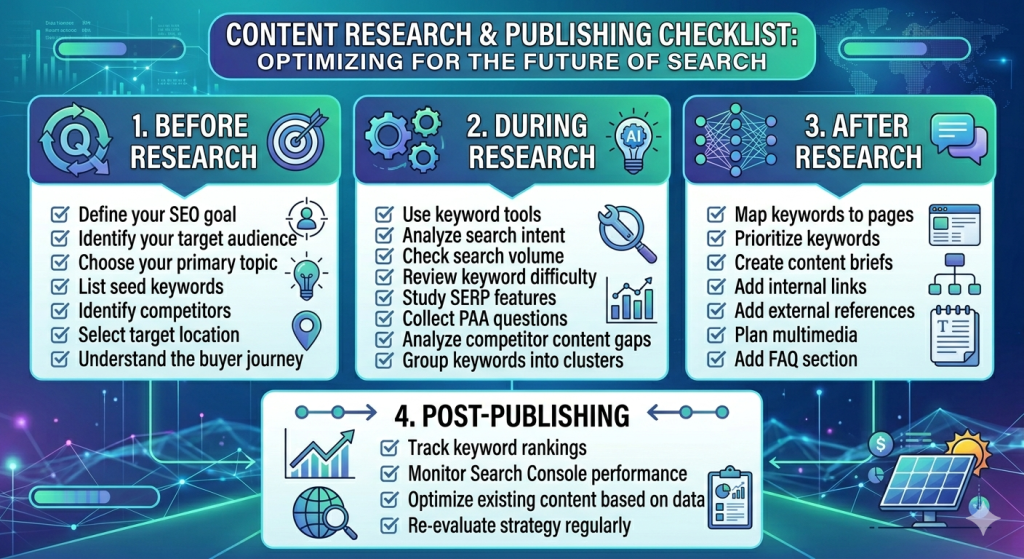
Keyword Research Checklist
Use this checklist before publishing content.
Before Research
- Define your SEO goal
- Identify your target audience
- Choose your primary topic
- List seed keywords
- Identify competitors
- Select target location
- Understand the buyer journey
During Research
- Use keyword tools
- Analyze search intent
- Check search volume
- Review keyword difficulty
- Study SERP features
- Collect People Also Ask questions
- Analyze competitor content gaps
- Group keywords into clusters
After Research
- Map keywords to pages
- Prioritize keywords
- Create content briefs
- Add internal links
- Add external references
- Plan multimedia
- Add FAQ section
- Track rankings and Search Console performance
How to Measure Keyword Research Success
Keyword research success should be measured with both SEO and business metrics.
Track:
- Organic impressions
- Organic clicks
- CTR
- Average ranking position
- Number of ranking keywords
- Featured snippet visibility
- AI Overview visibility
- Leads
- Sales
- Affiliate clicks
- Form submissions
- Content-assisted conversions
Google Search Console is useful for measuring queries, impressions, clicks, and average position.
Review your keyword strategy regularly. For active SEO campaigns, update keyword research monthly. For stable websites, review it at least every quarter.
FAQ About Keyword Research
What is keyword research?
Keyword research is the process of finding and analyzing the words, phrases, and questions people use when searching online.
Why is keyword research important?
Keyword research is important because it helps you create content that matches real user demand, search intent, and business goals.
How do I do keyword research for SEO?
Start with seed keywords, use keyword tools, analyze search intent, study competitors, group keywords into clusters, map them to pages, and prioritize them by value.
What is the best keyword research tool?
The best tool depends on your goal. Google Search Console is best for real website data, Google Trends is best for trends, and tools like Ahrefs or Semrush are useful for competitor and keyword analysis.
What are long-tail keywords?
Long-tail keywords are longer, more specific search phrases. They usually have lower competition and stronger intent.
What is search intent?
Search intent is the reason behind a search. It tells you whether the user wants to learn, compare, buy, or find a specific website.
How many keywords should I use in one article?
One article should target one primary keyword and several closely related secondary and semantic keywords.
What is keyword mapping?
Keyword mapping is the process of assigning keywords to specific pages so each page has a clear SEO purpose.
Is keyword research still important for AI search?
Yes. Keyword research helps you understand the questions, prompts, topics, and entities people use in AI-powered search tools.
How often should I update keyword research?
You should update keyword research monthly for active campaigns and quarterly for established websites.
Conclusion
Keyword research is more than finding popular search terms. It is the process of understanding your audience, analyzing search intent, identifying opportunities, and creating content that can rank, answer questions, and drive business results.
A strong keyword research strategy should include seed keywords, long-tail keywords, competitor analysis, SERP research, keyword clustering, keyword mapping, and content prioritization.
It should also support modern search experiences such as AI Overviews, answer engines, and LLM-based discovery.
If you want better SEO results, do not start with writing.
Start with keyword research.
Then build helpful, complete, well-structured content around what your audience is already searching for.
Resources
Use these trusted resources to improve your keyword research process:
